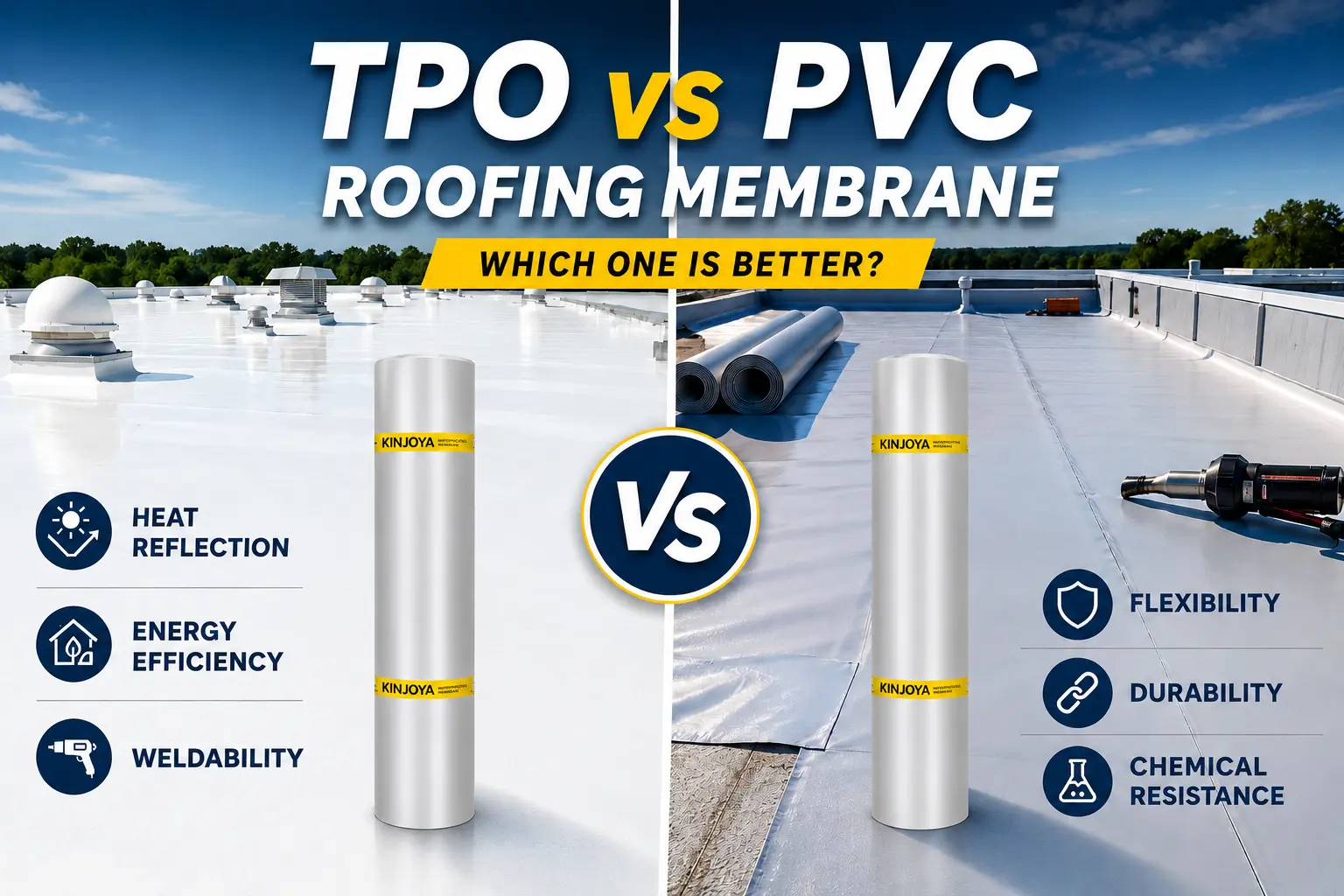
For most commercial and industrial flat roofs, TPO roofing membrane is often the better value when the main priorities are heat reflection, cost control, lightweight installation, and reliable weather resistance. PVC roofing membrane is usually the better choice when the roof is exposed to grease, oils, chemicals, restaurant exhaust, industrial discharge, or complex detailing where weldability and long-term chemical resistance are critical.
The right choice is not simply about which membrane is “stronger.” It depends on roof use, substrate condition, climate, chemical exposure, project budget, installation method, and expected service life. A warehouse roof, a restaurant roof, a factory roof, and a logistics center may all require different waterproofing decisions.
TPO vs PVC Roofing Membrane: Quick Comparison
| Factor | TPO Roofing Membrane | PVC Roofing Membrane |
|---|---|---|
| Material Type | Thermoplastic polyolefin membrane, usually reinforced for roof applications | Polyvinyl chloride membrane with plasticizers, stabilizers, and reinforcement options |
| Best For | Large flat roofs, warehouses, commercial buildings, general waterproofing projects | Restaurants, food factories, chemical exposure areas, industrial roofs, complex details |
| Seam Method | Hot-air welded seams | Hot-air welded seams |
| Heat Reflection | Excellent, especially in white or light-colored membranes | Excellent, especially in white or light-colored membranes |
| Chemical Resistance | Good for general roof exposure, but less suitable for grease, oils, and some chemicals | Generally stronger resistance to grease, oils, animal fats, and many chemicals |
| Flexibility | Good flexibility, but may require more installation control during welding | Good flexibility and often easier for detailed welding work |
| Cost Level | Usually more economical | Usually higher initial cost |
| Maintenance Focus | Regular seam inspection, puncture checks, and drainage maintenance | Regular inspection around exhaust, chemicals, seams, and detail areas |
When Is TPO Roofing Membrane the Better Choice?
TPO roofing membrane is a practical option for large flat roofs where the building owner needs a balance of waterproofing performance, energy efficiency, and project budget control. It is widely used on warehouses, shopping centers, logistics facilities, factories, schools, and general commercial buildings.
Because TPO is typically available in reflective colors, it can help reduce roof surface temperature in hot climates. For buildings with large roof areas, this can be a meaningful advantage because the roof becomes part of the building’s long-term energy strategy, not just a waterproofing layer.
Choose TPO when your project needs:
A cost-effective single-ply waterproofing membrane for a large roof area
Strong UV resistance and heat reflection
Hot-air welded seams for reliable waterproofing continuity
A lightweight roofing system suitable for metal, concrete, or plywood decks
Good long-term performance under normal commercial roof exposure
For many standard flat roof waterproofing projects, TPO offers the best balance between performance and cost. It is especially attractive when the roof is not exposed to grease exhaust, harsh chemicals, or industrial pollutants.
When Is PVC Roofing Membrane the Better Choice?
PVC roofing membrane is often selected when the project requires stronger resistance to chemicals, grease, oils, animal fats, or difficult rooftop conditions. This makes PVC a preferred choice for restaurants, commercial kitchens, food processing plants, chemical facilities, and industrial buildings where exhaust or airborne contaminants may contact the roof surface.
PVC is also valued for its weldability and detailing performance. On roofs with many penetrations, corners, equipment bases, parapets, drains, skylights, and complicated transitions, the membrane’s ability to form secure hot-air welded details becomes very important.
Choose PVC when your project needs:
Better resistance to grease, oils, animal fats, and certain chemicals
Reliable performance around restaurants, kitchens, and industrial exhaust systems
Strong hot-air welded seams and prefabricated accessory options
Good flexibility for complex roof details
A waterproofing membrane suitable for demanding commercial or industrial environments
The initial cost of PVC membrane may be higher than TPO, but in chemically exposed environments, the wrong membrane choice can lead to premature aging, seam failure, leakage, and costly repairs. In those conditions, PVC can provide better long-term value.
Is TPO or PVC More Durable?
Both TPO and PVC can be durable when the correct membrane thickness, reinforcement, installation method, and maintenance plan are used. Durability depends less on the product name alone and more on whether the membrane matches the actual roof environment.
TPO performs well on general commercial roofs where the main exposure is sunlight, rain, heat, wind, and normal maintenance traffic. PVC performs better when the roof faces chemical exposure, grease, industrial discharge, or complex waterproofing details.
If a roof has frequent foot traffic, rooftop equipment maintenance, sharp objects, poor drainage, or mechanical damage risk, the project should consider thicker membrane, protection walkway pads, reinforced detailing, and a proper maintenance schedule. No membrane should be treated as a “fit and forget” product.
Which Membrane Has Better Seam Performance?
Both TPO and PVC roofing membranes use hot-air welded seams. This is one of the biggest advantages of thermoplastic single-ply roofing systems because properly welded seams can create a continuous waterproofing layer without relying only on adhesives or tapes.
However, seam quality depends heavily on installer skill, welding temperature, machine speed, weather conditions, surface cleanliness, and quality control testing. A good membrane installed poorly can fail earlier than an average membrane installed correctly.
Important seam quality checks include:
Trial welding before full installation
Cleaning membrane surfaces before welding
Controlling welding speed and temperature
Using hand welding carefully around corners and penetrations
Probe testing completed seams after cooling
Repairing voids, fish-mouths, wrinkles, or cold welds immediately
For buyers, seam performance should be part of supplier evaluation. Ask not only about membrane thickness, but also about welding accessories, installation guidance, technical support, and compatible adhesives or detailing materials.
TPO vs PVC Cost: Which Offers Better Value?
TPO usually has a lower material cost and can be attractive for large roof areas where budget control is important. For a standard warehouse or commercial flat roof with low chemical exposure, TPO may provide the better overall value.
PVC usually costs more at the beginning, but it may reduce long-term risk in demanding environments. If a roof is above a restaurant, food processing area, chemical workshop, or industrial exhaust zone, selecting TPO only because of lower upfront cost may create higher repair costs later.
When comparing cost, consider the full roofing system:
Membrane thickness and reinforcement
Insulation and cover board requirements
Fasteners, plates, adhesives, and accessories
Drainage improvement and substrate repair
Labor cost and installation complexity
Detailing around equipment, parapets, drains, and penetrations
Maintenance cost over the service life
A low membrane price does not always mean a low roof system cost. A roof with many details, poor substrate condition, or chemical exposure may require a more robust system from the beginning.
Which One Is Better for Hot Climates?
Both TPO and PVC roofing membranes can be suitable for hot climates, especially when light-colored or reflective surfaces are used. The decision should be based on roof use and exposure rather than temperature alone.
For a large flat roof in a hot region with normal weather exposure, TPO is often a practical choice because it combines reflectivity, weldable seams, and competitive cost. For hot-climate roofs exposed to grease, oils, or industrial chemicals, PVC is usually the safer specification.
Hot-climate selection tips:
Choose reflective membrane colors when energy performance is important
Confirm UV resistance and dimensional stability
Use proper insulation to reduce heat transfer into the building
Design adequate drainage to avoid ponding water
Inspect seams and flashing details after extreme heat cycles
Which One Is Better for Restaurants and Food Processing Facilities?
PVC roofing membrane is generally the better choice for restaurants, commercial kitchens, food factories, and facilities with grease exhaust. Rooftop exhaust can carry oils, fats, and contaminants that may shorten the service life of less suitable membranes.
For these projects, the roof specification should not focus only on waterproofing. It should also consider chemical compatibility, exhaust discharge location, grease accumulation, maintenance access, and cleaning procedures.
Recommended approach for grease-exposed roofs:
Use PVC or another membrane system specifically suitable for grease and oil exposure
Install protection around exhaust fans and service areas
Improve exhaust discharge management where possible
Clean grease accumulation regularly
Inspect seams, drains, and flashing details more frequently
In this type of application, choosing the wrong membrane can cause hardening, surface damage, seam weakness, and leakage risk. The roof should be designed as a complete waterproofing and maintenance system.
Which One Is Better for Metal Roof Retrofit?
Both TPO and PVC can be used in metal roof waterproofing or retrofit projects when the system is properly designed. The key is to evaluate the existing roof condition before choosing the membrane.
Metal roofs often have issues such as loose fasteners, corrosion, moving seams, thermal expansion, skylight leakage, gutter problems, and weak panel laps. A membrane system can solve many leak problems, but only if the substrate is repaired and prepared correctly.
Before installing TPO or PVC over a metal roof, check:
Rust and corrosion level
Loose screws or failed fasteners
Panel movement and structural stability
Existing insulation and condensation risk
Drainage and gutter performance
Compatibility between membrane, adhesive, and substrate
For general metal roof retrofit projects, TPO may be the more economical option. For industrial metal roofs with chemical exposure, PVC may be more suitable.
Common Mistakes When Choosing Between TPO and PVC
1. Choosing Only Based on Material Price
The cheapest membrane may not be the cheapest roof. If the membrane is not suitable for the building environment, repair and replacement costs can quickly exceed the initial savings.
2. Ignoring Chemical Exposure
Grease, oils, acids, solvents, exhaust fumes, and industrial pollutants can affect membrane performance. Always identify rooftop exposure before selecting TPO or PVC.
3. Underestimating Roof Details
Roofs with many penetrations, corners, equipment bases, and parapet transitions need careful detailing. Membrane selection should consider weldability and accessory compatibility.
4. Not Checking Drainage
Ponding water increases stress on seams, flashing, and membrane surfaces. Good drainage design is essential for both TPO and PVC roofing systems.
5. Treating Installation as a Minor Factor
Installation quality directly affects service life. Proper welding, substrate preparation, seam testing, and detail work are just as important as membrane selection.
How to Choose the Right Roofing Membrane for Your Project
To make a reliable purchasing decision, evaluate the roof as a complete system rather than comparing TPO and PVC as isolated materials.
Use this selection checklist:
Roof type: Is it concrete, metal, plywood, or an existing waterproofing layer?
Building use: Is it a warehouse, restaurant, factory, mall, school, or logistics center?
Exposure: Will the roof contact grease, oils, chemicals, exhaust, or pollutants?
Climate: Is the project in a hot, cold, humid, coastal, or high-UV region?
Traffic: Will technicians regularly access rooftop equipment?
Drainage: Is there ponding water or poor slope?
Budget: Is the priority lowest initial cost or lowest long-term risk?
Installation: Are trained installers and welding equipment available?
Accessories: Are compatible adhesives, corners, flashing, and detail materials available?
If the roof has normal weather exposure and a large surface area, TPO is often a strong choice. If the roof has grease, chemical exposure, or complex waterproofing details, PVC is usually the safer option.
Practical Recommendation by Application
| Application | Recommended Option | Reason |
|---|---|---|
| Warehouse flat roof | TPO | Good balance of cost, reflectivity, and waterproofing performance |
| Shopping center roof | TPO or PVC | Depends on tenant mix, rooftop equipment, and exhaust exposure |
| Restaurant roof | PVC | Better resistance to grease, oils, and kitchen exhaust |
| Food processing facility | PVC | More suitable for chemical and grease-related exposure |
| General industrial roof | TPO or PVC | Choose based on chemical exposure and maintenance traffic |
| Metal roof retrofit | TPO or PVC | TPO for general retrofit; PVC for chemical or grease exposure |
| Roof with many penetrations | PVC | Often better for complex detailing and welded accessories |
FAQ: TPO vs PVC Roofing Membrane
Is TPO better than PVC roofing?
TPO is better for many standard commercial flat roofs where budget, reflectivity, and general weather resistance are the main priorities. PVC is better for roofs exposed to grease, oils, chemicals, or complicated detailing requirements.
Is PVC roofing membrane worth the higher cost?
Yes, PVC can be worth the higher cost when the roof environment is demanding. Restaurants, food factories, chemical facilities, and industrial roofs may benefit from PVC because it reduces the risk of chemical-related membrane damage.
Can TPO and PVC roofing membranes be repaired?
Yes. Both membranes can usually be repaired by cleaning the damaged area and welding a compatible patch. Repairs should be performed by trained installers using the correct membrane type and welding conditions.
Which membrane is better for energy efficiency?
Both TPO and PVC can support energy efficiency when installed in reflective colors. The total energy performance also depends on insulation, roof design, building use, and local climate.
Which roofing membrane lasts longer?
Service life depends on membrane quality, thickness, roof exposure, installation quality, drainage, and maintenance. PVC may perform better in chemically exposed environments, while TPO can provide strong long-term value on standard commercial roofs.
Can TPO or PVC be installed over an existing roof?
In some retrofit projects, yes. However, the existing roof must be inspected for moisture, structural damage, adhesion problems, drainage issues, and compatibility. A separation layer, insulation board, or cover board may be required.
Final Recommendation: Which One Should You Choose?
Choose TPO roofing membrane if your project is a standard commercial or industrial flat roof and you need a cost-effective, reflective, hot-air weldable waterproofing system. It is a strong option for warehouses, logistics centers, shopping centers, and large roof areas with normal environmental exposure.
Choose PVC roofing membrane if your roof is exposed to grease, oils, chemicals, restaurant exhaust, food processing emissions, or complex waterproofing details. In these environments, PVC’s higher initial cost can be justified by better long-term protection and lower leakage risk.
For the most reliable result, select the membrane based on real roof conditions, not only product price. A professional waterproofing supplier can help review the substrate, exposure level, climate, drainage, installation method, and detail requirements before recommending the final system.
Need Help Selecting a Roofing Membrane?
KINJOYA supplies waterproofing materials and roofing membrane systems for commercial, industrial, and infrastructure projects. Whether your project requires TPO membrane, PVC waterproofing membrane, modified bitumen membrane, waterproof coating, or a complete flat roof waterproofing system, the right solution should be selected according to roof structure, exposure condition, climate, and service-life expectations.
Contact KINJOYA with your project details, including roof area, substrate type, climate, application method, drainage condition, and exposure environment. Our team can help recommend a practical waterproofing system for your project.