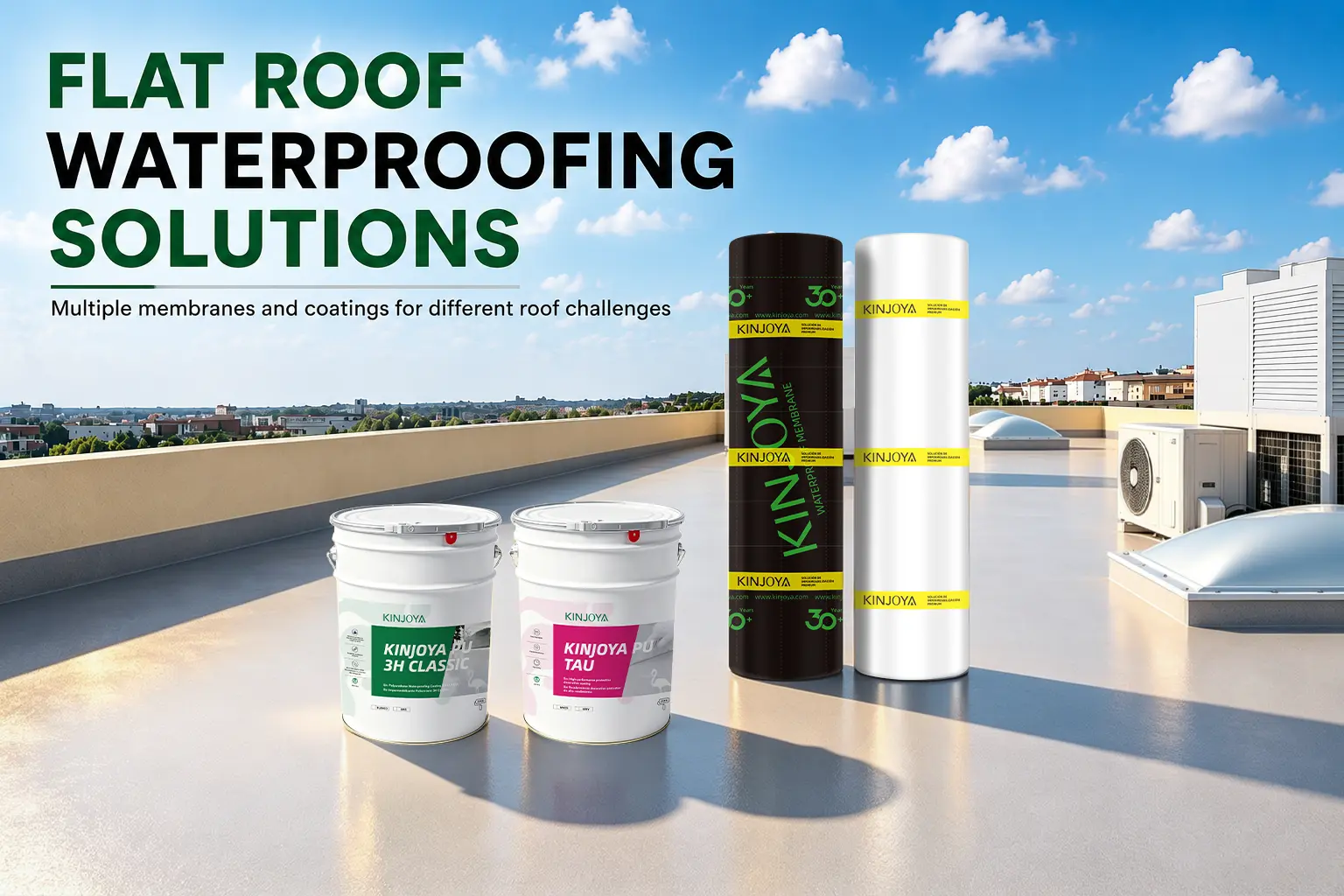
The best waterproofing system for flat roofs is usually not a single product, but a complete system selected according to roof structure, climate, drainage, exposure, traffic, and budget. For large commercial roofs, TPO or PVC membrane systems are often strong choices. For concrete roofs, basements, podiums, and roofs with movement risk, SBS or APP modified bitumen membranes can be more suitable. For renovation, complex details, and metal roof repair, liquid-applied waterproof coatings may provide better flexibility and easier installation.
Flat roofs have a higher leakage risk than sloped roofs because rainwater drains more slowly. Even small defects around seams, drains, parapets, skylights, pipe penetrations, or equipment bases can become serious leakage points. Therefore, the best flat roof waterproofing solution must combine the right material, correct substrate preparation, reliable detailing, and regular maintenance.
Flat Roof Waterproofing System Comparison
| Waterproofing System | Best For | Main Advantages | Key Limitations |
|---|---|---|---|
| TPO Roofing Membrane | Large commercial and industrial flat roofs | Reflective surface, hot-air welded seams, lightweight system, good cost-performance balance | Requires skilled welding and careful detailing around penetrations |
| PVC Roof Membrane | Restaurants, factories, chemical exposure roofs, complex commercial roofs | Good chemical resistance, hot-air welded seams, strong detailing performance | Usually higher initial material cost than TPO |
| SBS Modified Bitumen Membrane | Concrete roofs, cold regions, roofs with movement or cracking risk | Excellent flexibility, crack-bridging ability, strong low-temperature performance | Needs correct protection if exposed to long-term UV |
| APP Modified Bitumen Membrane | Hot-climate exposed flat roofs | Good heat resistance, UV stability, durable torch-applied waterproofing layer | Less flexible than SBS in cold or movement-sensitive areas |
| Polyurethane Waterproof Coating | Concrete roofs, balconies, complex details, renovation projects | Seamless layer, strong adhesion, good flexibility, easy detail coverage | Requires strict surface preparation and correct coating thickness |
| Acrylic Roof Coating | Exposed roofs, maintenance coating, reflective roof restoration | Good reflectivity, easy application, cost-effective maintenance option | Not ideal for long-term ponding water unless specified for that condition |
| Silicone Roof Coating | Roofs with ponding water risk and exposed restoration projects | Excellent water resistance, UV resistance, and weathering performance | Surface can attract dirt and may require special preparation for recoating |
For new commercial flat roofs, membrane systems are often preferred because they provide consistent thickness and controlled factory-made quality. For renovation or complex roof details, liquid-applied coatings can be practical because they form a seamless waterproofing layer directly over the prepared substrate.
What Makes Flat Roof Waterproofing Different?
Flat roofs are not completely flat. They should have a designed slope that directs water toward drains, gutters, or scuppers. However, compared with pitched roofs, flat roofs still hold water longer, making waterproofing performance more demanding.
The biggest waterproofing risks on flat roofs are not usually in the middle of the roof field. They usually appear around weak points such as drainage outlets, parapet walls, expansion joints, roof equipment, pipe penetrations, skylights, old cracks, lap seams, and poorly repaired areas.
Flat roof waterproofing must solve these problems:
Slow drainage and ponding water
Thermal expansion and contraction
Concrete cracking or metal roof movement
UV exposure and surface aging
Foot traffic from maintenance workers
Seam failure or poor lap treatment
Leakage around drains, pipes, skylights, and parapets
Compatibility with insulation, screed, primer, adhesive, or old waterproofing layers
A good flat roof waterproofing system should be selected after checking the roof condition, not only after comparing product names. The same material may perform well on one roof and fail early on another if the roof structure and site conditions are ignored.
Best Waterproofing System for New Commercial Flat Roofs
For new commercial and industrial flat roofs, TPO and PVC single-ply membrane systems are often strong options. They are lightweight, suitable for large roof areas, and use hot-air welded seams to create continuous waterproofing protection.
TPO is often selected for warehouses, logistics centers, shopping centers, schools, and general commercial buildings where the roof has normal weather exposure. It offers a good balance of cost, reflectivity, waterproofing performance, and installation efficiency.
PVC is often selected for buildings with grease, oil, chemical, or industrial exposure. Restaurants, food processing plants, chemical workshops, and factories may benefit from PVC because it generally provides better resistance to demanding rooftop contaminants.
Recommended system for new commercial flat roofs:
TPO membrane for large standard commercial roofs with normal exposure
PVC membrane for roofs exposed to grease, oils, chemicals, or complex equipment areas
Reinforced membrane for better dimensional stability and mechanical strength
Compatible insulation and cover board if thermal performance or substrate protection is needed
Hot-air welded seams with seam testing after installation
Walkway pads around rooftop equipment and maintenance paths
For purchasing decisions, buyers should confirm membrane thickness, reinforcement type, roll size, welding requirements, accessory compatibility, and technical installation support. The membrane itself is only one part of the roof system.
Best Waterproofing System for Concrete Flat Roofs
For concrete flat roofs, SBS modified bitumen membrane, APP modified bitumen membrane, and polyurethane waterproof coating are common choices. The best option depends on whether the roof is exposed, covered, cracked, old, new, hot, cold, or subject to structural movement.
SBS modified bitumen membrane is often preferred when flexibility and crack-bridging ability are important. Concrete roofs may develop shrinkage cracks, movement cracks, or construction joint leakage, so a flexible membrane can reduce long-term leakage risk.
APP modified bitumen membrane is often preferred for exposed concrete roofs in hot climates. It provides strong heat resistance and weathering performance, especially when supplied with a suitable mineral, aluminum foil, or exposed-grade surface.
Polyurethane waterproof coating is suitable for concrete roofs with complex corners, upstands, pipe penetrations, drainage details, and irregular surfaces. Because it is liquid-applied, it can form a seamless layer when the coating thickness and surface preparation are properly controlled.
Recommended system for concrete flat roofs:
SBS membrane for movement-sensitive concrete roofs and cold climates
APP membrane for exposed concrete roofs in hot climates
PU waterproof coating for complex details, cracks, and renovation work
Primer to improve adhesion between substrate and waterproofing layer
Reinforcement fabric around cracks, corners, drains, and joints where needed
Protection layer if the waterproofing system will be covered by screed, tiles, or insulation
Before waterproofing a concrete flat roof, the surface should be dry, clean, solid, and free from dust, oil, loose mortar, sharp edges, and standing water. Most failures on concrete roofs are caused by poor surface preparation or weak detail treatment.
Best Waterproofing System for Old Flat Roof Renovation
For old flat roof renovation, the best system depends on the condition of the existing waterproofing layer. If the old membrane is severely damaged, loose, blistered, wet underneath, or poorly bonded, full removal may be necessary. If the existing roof is generally stable, a restoration system may be possible.
Liquid-applied waterproof coatings are often useful for renovation because they can cover irregular surfaces, existing details, small cracks, and complicated roof areas without creating many seams. Polyurethane, acrylic, and silicone coatings are common choices depending on roof exposure and ponding water conditions.
Before choosing a renovation system, inspect:
Existing membrane adhesion
Moisture trapped under the old waterproofing layer
Blisters, wrinkles, cracks, and loose laps
Drainage condition and ponding water areas
Parapet wall cracks and flashing failure
Compatibility between old and new waterproofing materials
Structural damage or concrete deterioration
If the existing roof has widespread hidden moisture, applying a new waterproofing layer over it may trap water and cause early failure. In that situation, repair, removal, drying, or replacement should be considered before installing the new system.
Best Waterproofing System for Metal Flat Roofs
Metal flat roofs and low-slope metal roofs often leak at fasteners, panel laps, seams, skylights, gutters, ridges, and penetrations. The best waterproofing system should handle thermal movement because metal expands and contracts with temperature changes.
For metal roof waterproofing, liquid-applied coatings are often practical because they can seal screws, seams, laps, and irregular details. Polyurethane coatings can provide strong adhesion and flexibility, while silicone coatings can be useful where water resistance and UV exposure are major concerns.
Recommended system for metal flat roofs:
Remove rust, loose coating, oil, and dust before application
Replace loose screws and repair damaged panels
Seal fastener heads, laps, and seams first
Use reinforcement fabric on movement-sensitive joints
Apply compatible primer for metal substrate
Use PU, silicone, or other suitable waterproof roof coating as the main layer
Maintain gutters and drainage paths regularly
A coating system can stop many metal roof leaks, but it should not be used to hide structural corrosion or unstable panels. If the metal roof has serious rust or weak panels, repair or replacement should be completed before waterproofing.
Best Waterproofing System for Roofs with Ponding Water
For flat roofs with ponding water, the first recommendation is to improve drainage whenever possible. Waterproofing materials can resist water, but long-term ponding water increases stress on seams, coatings, flashing details, and roof structure.
If drainage cannot be fully corrected, the waterproofing system must be selected carefully. Silicone roof coating is often used in exposed roof restoration projects where ponding water resistance is important. PVC membrane can also be a strong option for certain flat roof systems, provided seams and details are correctly welded.
For ponding water areas, consider:
Improving roof slope with screed or tapered insulation
Adding or enlarging drains, scuppers, or overflow outlets
Using waterproofing materials suitable for continuous water exposure
Reinforcing drains, corners, and low points
Avoiding materials that are not designed for long-term standing water
Inspecting ponding areas after heavy rain
Buyers should be cautious when a supplier claims that one coating can solve all ponding water problems. Long-term performance depends on product type, dry film thickness, adhesion, surface preparation, drainage design, and maintenance.
Membrane vs Coating: Which Is Better for Flat Roof Waterproofing?
Membranes are usually better for new roofs, large roof areas, and projects that require consistent factory-controlled thickness. Coatings are usually better for renovation, maintenance, complex details, irregular surfaces, and projects where a seamless liquid-applied layer is preferred.
| Factor | Flat Roof Waterproofing Membrane | Waterproof Coating |
|---|---|---|
| Thickness Control | Factory-made thickness is more consistent | Depends on application rate and number of coats |
| Seams | Has seams or overlaps that must be welded or bonded correctly | Can form a seamless layer when properly applied |
| Large Roof Areas | Very suitable for large commercial roofs | Suitable, but application thickness control is critical |
| Complex Details | Requires skilled cutting, welding, flashing, and accessories | Often easier around pipes, corners, drains, and irregular shapes |
| Renovation | May require removal or separation layer depending on old roof condition | Often suitable when existing roof is stable and compatible |
| Installation Risk | Seam quality and detail work are critical | Surface preparation and coating thickness are critical |
In many flat roof projects, the best solution may combine both approaches. For example, a membrane may be used for the main roof field, while liquid coating or compatible sealant may be used for complex details, repairs, or reinforcement areas.
How to Choose the Right Flat Roof Waterproofing System
To choose the right flat roof waterproofing system, start with a roof condition assessment. The roof substrate, drainage, exposure, climate, traffic, and existing waterproofing layer should all be reviewed before selecting materials.
Use this selection checklist:
Roof substrate: Concrete, metal, plywood, insulation board, or existing membrane
Roof condition: New construction, renovation, cracked surface, old coating, or damaged membrane
Climate: Hot, cold, humid, coastal, tropical, or freeze-thaw environment
Exposure: UV, chemicals, grease, oils, industrial emissions, or foot traffic
Drainage: Good slope, slow drainage, blocked drains, or ponding water
Application method: Hot-air welding, torch application, self-adhesive, or liquid-applied coating
Fire safety: Whether open flame is allowed on the project site
Maintenance access: Whether rooftop equipment requires regular service
Budget: Initial material cost, labor cost, protection layer cost, and long-term repair cost
The best system is the one that matches the roof’s real risk factors. A warehouse roof, a restaurant roof, a residential concrete roof, and an old metal roof should not automatically use the same waterproofing system.
Recommended Flat Roof Waterproofing System by Application
| Application | Recommended System | Reason |
|---|---|---|
| Large warehouse roof | TPO membrane | Good cost-performance balance, reflective surface, suitable for large areas |
| Restaurant roof | PVC membrane | Better resistance to grease, oils, and kitchen exhaust exposure |
| Concrete roof in cold climate | SBS modified bitumen membrane | Better low-temperature flexibility and crack-bridging ability |
| Exposed concrete roof in hot climate | APP modified bitumen membrane | Better heat resistance and UV stability |
| Old roof renovation | PU, acrylic, or silicone coating | Can restore compatible existing roof surfaces with fewer seams |
| Metal roof leakage repair | PU or silicone waterproof coating | Good for sealing screws, laps, seams, and irregular details |
| Roof with many pipe penetrations | PU coating or PVC membrane with proper detailing | Better detail coverage and waterproofing continuity |
| Roof with ponding water risk | Drainage improvement plus silicone coating or suitable membrane system | Material selection must be combined with drainage correction |
This table can help with early product selection, but final system design should still consider roof inspection results, local climate, installation conditions, and project specification requirements.
Common Flat Roof Waterproofing Mistakes
1. Waterproofing without fixing drainage
Ponding water is one of the main causes of flat roof failure. If drainage is poor, even a high-quality waterproofing system may age faster or fail at weak points.
2. Applying coating too thin
Liquid-applied waterproof coatings must reach the required dry film thickness. A thin coating may look finished but fail under UV, water, movement, or foot traffic.
3. Ignoring substrate moisture
Moisture trapped under a membrane or coating can cause blistering, poor adhesion, and hidden deterioration. Substrate dryness should be checked before installation.
4. Treating details as secondary work
Drains, corners, parapets, expansion joints, and penetrations are high-risk areas. They often need primer, reinforcement fabric, additional coating thickness, flashing, or special accessories.
5. Choosing the system only by price
The cheapest waterproofing material can become expensive if it fails early. Buyers should compare total system cost, installation quality, service life, maintenance, and leakage risk.
6. Using incompatible materials
Some coatings, primers, sealants, and membranes are not compatible with each other. Compatibility should be confirmed before applying a new system over an old roof.
How Long Does Flat Roof Waterproofing Last?
The service life of flat roof waterproofing depends on material quality, system design, installation quality, climate, roof traffic, drainage, maintenance, and exposure conditions. A well-designed membrane or coating system can provide long-term protection, but poor installation can cause leakage much earlier.
Factors that affect service life include:
Membrane thickness or coating dry film thickness
Reinforcement type and system design
Substrate preparation and primer use
Seam welding, lap bonding, or coating continuity
UV exposure and surface protection
Ponding water and drainage quality
Foot traffic and mechanical damage
Inspection and maintenance frequency
For long-term performance, flat roofs should be inspected at least after severe weather, heavy rain, construction work, rooftop equipment maintenance, or visible damage. Early repair is much cheaper than full system replacement.
FAQ: Best Waterproofing System for Flat Roofs
What is the best waterproofing for a flat concrete roof?
For a flat concrete roof, SBS modified bitumen membrane, APP modified bitumen membrane, and polyurethane waterproof coating are common choices. SBS is better for movement and cracks, APP is better for hot exposed roofs, and PU coating is useful for complex details and renovation work.
Is membrane better than coating for flat roofs?
Membrane is often better for new roofs and large commercial areas because it has consistent factory-made thickness. Coating is often better for renovation, irregular details, and seamless repair work. The better option depends on roof condition and project purpose.
Can waterproof coating stop flat roof leaks?
Yes, waterproof coating can stop many flat roof leaks when the substrate is properly prepared and the coating is applied at the correct thickness. However, active structural cracks, trapped moisture, serious ponding water, or damaged substrate must be repaired first.
What is the best system for flat roofs with standing water?
The best solution is to improve drainage first. If standing water cannot be fully avoided, select a system suitable for ponding water, such as a suitable silicone coating or properly installed membrane system. Drains, seams, and low points need extra attention.
Can I waterproof over an old flat roof?
Yes, but only if the existing roof is stable, dry, clean, and compatible with the new waterproofing system. Loose membrane, trapped moisture, blisters, severe cracks, or weak adhesion should be repaired or removed before applying a new system.
Which flat roof waterproofing system is most cost-effective?
For large standard commercial roofs, TPO membrane is often cost-effective. For concrete roofs with movement risk, SBS membrane may provide better long-term value. For renovation, waterproof coating can be economical if the existing roof is suitable for restoration.
Final Recommendation: Which Flat Roof Waterproofing System Should You Choose?
Choose TPO membrane for large commercial flat roofs where cost efficiency, reflectivity, and reliable welded seams are important. Choose PVC membrane for restaurants, factories, and roofs exposed to grease, oils, chemicals, or complex rooftop equipment. Choose SBS modified bitumen membrane for concrete roofs, cold regions, and movement-sensitive structures. Choose APP modified bitumen membrane for exposed roofs in hot and sunny climates. Choose polyurethane, acrylic, or silicone waterproof coatings for renovation, metal roof repair, complex details, or roof restoration projects.
The best flat roof waterproofing system is the one that matches the actual roof condition. Before purchasing, check the substrate, drainage, climate, exposure, roof traffic, existing waterproofing layer, installation method, and long-term maintenance plan.
KINJOYA supplies waterproofing membranes, modified bitumen membranes, waterproof coatings, and flat roof waterproofing system solutions for commercial, industrial, residential, and infrastructure projects. Share your project details with KINJOYA to receive a practical waterproofing recommendation based on roof structure, climate, application scenario, and long-term performance requirements.