

General Inquiries

Interior Foundation Waterproofing

Interior foundation wall waterproofing addresses basement internal walls like partitions and equipment room walls. Although not directly contacting soil, they can become damp or moldy due to capillary action, condensation, or slab leaks, affecting indoor environmental quality and equipment safety. This waterproofing focuses on preventing moisture migration through walls or structural cracks into interior spaces. Materials are typically chosen for environmental friendliness and ease of application, such as breathable coatings or damp-proof layers. Suitable for basement partitions, storerooms, and utility areas, it enhances comfort and functionality of underground spaces, preventing health risks from dampness.

INTERIOR FOUNDATION WATERPROOFING PRODUCTS

KINJOYA POLYMER CEMENT
Two-component water-based coating made from acrylate polymer emulsion and cement. Solvent-free, non-combustible, non-toxic. Offers aging resistance, low-temperature flexibility, high adhesion, water resistance, and crack resistance.
View Product
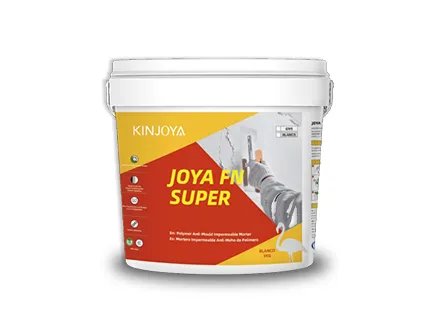
JOYA FN SUPER
Multi-functional single-component dry-mix material of specialty cement, quartz sand, polymer powder, and additives. Delivers repairing, leveling, waterproofing, moisture resistance, and mold resistance.
View Product

Special Requirements for Interior Foundation Wall Waterproofing Materials

Balance Between Moisture Resistance and Vapor Permeability

Interior foundation wall waterproofing must effectively block soil moisture and capillary water while maintaining certain vapor permeability, preventing trapped moisture from causing finish layer delamination. Materials should allow slow passage of water vapor molecules while preventing liquid water penetration, maintaining wall breathability and indoor environmental comfort.

Environmental Safety and Decorative Compatibility

Basement spaces typically have limited ventilation, requiring waterproofing materials to meet strict environmental standards without releasing harmful substances during application and service. Materials must also exhibit good adhesion with subsequent finishes, allowing plastering, tiling, or decorative coating application without compromising interior aesthetics and space utilization.

Balance Between Moisture Resistance and Vapor Permeability
Environmental Safety and Decorative Compatibility

Interior Foundation Wall Waterproofing and Basement Ventilation Systems

Synergy Between Waterproofing and Ventilation

Waterproofing layers primarily block liquid water penetration, while ventilation systems address vapor moisture issues. Even with proper basement waterproofing installation, moisture vapor generated by daily activities and dampness slowly permeates through walls and requires timely exhaust outdoors. Proper ventilation reduces indoor relative humidity, prevents wall condensation, and alleviates waterproofing burden. Their combination creates dual protection for dry environments.

Moisture Sources and System Division

Basement moisture sources primarily include soil dampness, condensation, and vapor from indoor activities. Waterproofing systems mainly block soil-derived liquid water and partial moisture vapor, while ventilation systems replace accumulated humid indoor air and eliminate condensation caused by temperature differences. The functions of both systems complement each other—relying solely on either system cannot achieve ideal moisture control, requiring coordinated operation.

Synergy Between Waterproofing and Ventilation
Moisture Sources and System Division

Key Considerations for Interior Foundation Wall Waterproofing Construction

Proper substrate preparation and detail control are essential. Clean wall surfaces thoroughly, filling all holes and cracks to achieve a smooth, sound substrate. Finish internal and external corners in rounded arcs to ensure continuous membrane coverage. Apply reinforcement at pipe penetrations and baseboards to prevent moisture infiltration. Waterproofing must be applied uniformly, achieving specified thickness without misses or runs. After application, maintain ventilation and allow full curing before finishing. For persistently damp basements, integrate moisture barriers and ventilation systems for comprehensive protection. Meticulous construction ensures long-term effectiveness and dry underground spaces.

Key Considerations for Interior Foundation Wall Waterproofing Construction
Get in Touch with KINJOYA Now!
Address
KINJOYA Updates
News1
Apr 29, 2026
News2
Apr 29, 2026
News3
Apr 29, 2026
view more news
We use cookies on this site, including third party cookies, to delivery experiennce for you.
Accept Cookies
Read Privacy Policy