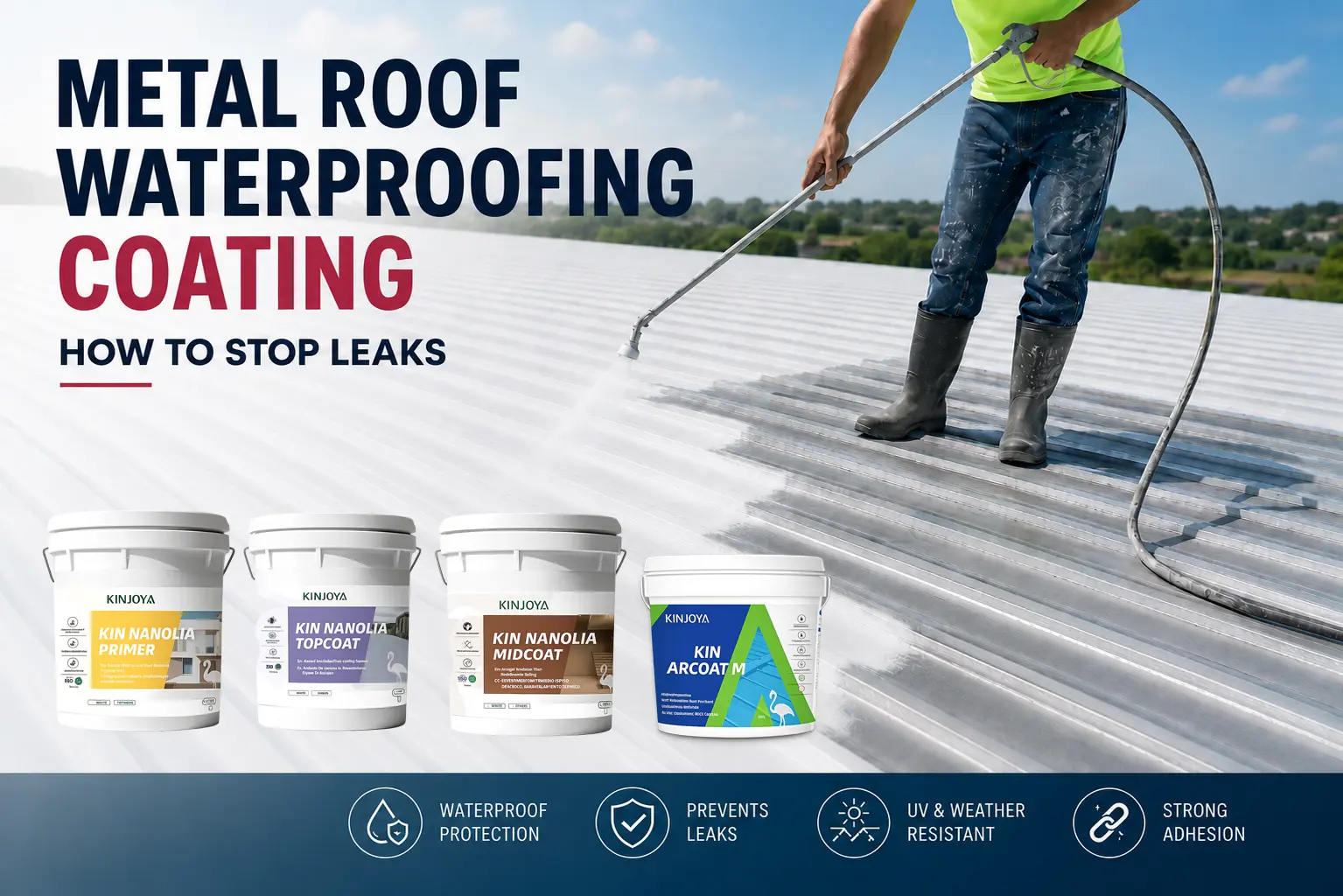
Metal roof leaks are usually caused by loose fasteners, failed seams, rust, cracked sealant, damaged flashing, skylight joints, gutter problems, or thermal movement. A waterproofing coating can stop many metal roof leaks, but only when the roof is properly inspected, repaired, cleaned, primed, reinforced, and coated at the correct thickness.
The most effective solution is not simply "paint over the roof." A metal roof waterproofing coating system should include rust treatment, fastener repair, seam sealing, reinforcement fabric on high-risk areas, compatible primer, and a durable topcoat such as polyurethane, acrylic, silicone, or other roof coating materials selected according to climate, roof condition, and water exposure.
Common Causes of Metal Roof Leaks
| Leak Source | Typical Problem | Recommended Repair Before Coating |
|---|---|---|
| Fasteners | Loose screws, missing washers, cracked rubber gaskets | Replace damaged fasteners and seal screw heads |
| Panel Seams | Open laps, failed sealant, movement gaps | Clean, seal, and reinforce seams with fabric |
| Rust Areas | Corrosion, pinholes, weakened metal surface | Remove rust, apply anti-rust primer, repair severe damage |
| Flashing | Cracked sealant around walls, curbs, pipes, and penetrations | Reseal and reinforce flashing transitions |
| Skylights | Aged sealant, frame movement, poor drainage | Repair joints and reinforce surrounding areas |
| Gutters and Valleys | Blocked drainage, standing water, backflow | Clean gutters, improve drainage, coat low-risk areas carefully |
| Roof Penetrations | Pipes, vents, HVAC bases, cable entries leaking at edges | Use sealant, flashing repair, and coating reinforcement |
Before applying any waterproof coating, the source of leakage must be identified. If the roof has structural damage, severe corrosion, unstable panels, or water entering from walls or drainage systems, coating alone may not solve the problem.
Can Waterproof Coating Really Stop Metal Roof Leaks?
Yes, waterproof coating can stop many metal roof leaks when the roof is still structurally sound. It is especially effective for leaks caused by small gaps, aging sealant, fastener heads, seams, minor cracks, and surface corrosion. A properly applied coating system creates a continuous waterproof layer over the metal surface and helps protect the roof from UV, rain, rust, and temperature changes.
However, waterproof coating is not a substitute for serious roof repair. If the metal panels are badly corroded, deformed, loose, or structurally unsafe, the damaged parts should be replaced before coating. If the roof slope or drainage is poor, water may continue to accumulate and reduce coating service life.
Waterproof coating is suitable when:
The metal roof is generally stable and structurally sound
Leaks come from seams, fasteners, laps, flashing, or minor cracks
Rust is light to moderate and can be treated
The existing roof surface can be cleaned and prepared properly
The building owner wants a cost-effective roof restoration solution
Full roof replacement is not necessary or not economical
Waterproof coating may not be enough when:
Metal panels have severe corrosion or holes
The roof structure is weak or unstable
There is serious ponding water caused by poor slope
Leaks come from walls, parapets, gutters, or condensation instead of roof surface defects
The old coating or paint is loose and cannot provide a stable base
A professional inspection is important because applying coating over hidden problems can trap moisture and delay necessary repairs.
Best Waterproofing Coatings for Metal Roofs
The best coating for a metal roof depends on roof condition, climate, exposure, movement, drainage, and budget. Polyurethane, acrylic, and silicone coatings are commonly used for metal roof waterproofing, but each material has different strengths.
| Coating Type | Best For | Main Advantages | Key Considerations |
|---|---|---|---|
| Polyurethane Waterproof Coating | Metal roofs with movement, seams, fasteners, and high waterproofing demand | Strong adhesion, good flexibility, durable waterproofing layer | Requires proper primer and controlled coating thickness |
| Acrylic waterproofing roof coating | Reflective roof restoration and maintenance coating | Cost-effective, UV reflective, easy to apply | Not ideal for long-term ponding water unless specifically formulated |
| Silicone Roof Coating | Exposed roofs with strong UV and ponding water risk | Excellent water resistance, UV resistance, and weathering performance | Surface can attract dirt; recoating may require special preparation |
| Bituminous Coating | Some low-cost repair and industrial waterproofing applications | Good water resistance and simple application | May have lower UV resistance unless protected; appearance may be less suitable for visible roofs |
| Hybrid Waterproof Coating | Projects requiring balanced adhesion, flexibility, and weather resistance | Can combine advantages of different resin systems | Performance depends heavily on formulation and supplier quality |
For many metal roof repair projects, polyurethane coating is a strong choice because metal roofs move with temperature changes. The coating must remain flexible while maintaining adhesion to the metal substrate. For roofs with long-term ponding water risk, silicone may be considered, but drainage improvement is still recommended whenever possible.
Step 1: Inspect the Metal Roof Before Applying Coating
A successful metal roof waterproofing project starts with a detailed inspection. Many leaks are not located directly above the visible indoor water stain. Water can travel along metal panels, purlins, insulation, or structural members before dripping into the building.
Inspect these areas carefully:
Fastener rows and screw washers
Panel laps and side seams
End laps and horizontal joints
Ridge caps and roof edges
Valleys, gutters, and drainage channels
Skylight frames and translucent panels
Pipe penetrations, vents, and cable entries
HVAC units, equipment bases, and curbs
Parapet wall connections and flashing details
Rust spots, pinholes, dents, and damaged panels
The inspection should identify whether the roof needs simple waterproof coating, local repair plus coating, or partial panel replacement before coating. This step prevents wasting material on a roof that is not ready for restoration.
Step 2: Repair Fasteners, Seams, and Damaged Panels
Loose or failed fasteners are one of the most common sources of metal roof leaks. Over time, wind uplift, thermal movement, vibration, and aging rubber washers can create gaps around screw heads. These small openings can allow water to enter the building during heavy rain.
Before coating, replace missing screws, tighten loose fasteners, and change damaged washers. Do not rely only on coating to hold unstable fasteners in place. If the screw hole is enlarged, a larger fastener or proper repair method may be required.
Recommended repair actions:
Replace loose, rusted, or missing screws
Repair enlarged screw holes
Seal fastener heads with compatible waterproof sealant
Close open panel laps and end laps
Replace severely rusted or punctured panels
Repair damaged flashing before coating
Secure moving panels where possible
If damaged panels are not repaired first, the waterproof coating may crack, detach, or fail early because the underlying roof continues to move or deteriorate.
Step 3: Remove Rust and Prepare the Surface
Surface preparation is one of the most important steps in metal roof waterproofing. Coating adhesion depends on a clean, dry, stable surface. Dust, rust, oil, old loose paint, chalking, and moisture can all reduce adhesion and cause premature peeling or blistering.
Basic surface preparation includes:
Remove loose rust with wire brushing, sanding, grinding, or mechanical cleaning
Clean dust, mud, oil, grease, and surface contaminants
Remove loose paint or failed old coating
Wash the roof surface if needed and allow it to dry completely
Treat rusted areas with anti-rust primer or corrosion-inhibiting primer
Check weather conditions before application
For industrial metal roofs, contamination from oil, chemicals, exhaust, or production dust may require stronger cleaning methods. The coating supplier should confirm the correct primer and cleaning method for the roof surface.
Step 4: Seal and Reinforce High-Risk Leak Areas
Most metal roof leaks occur at details, not in the middle of a flat panel. Before applying the main waterproof coating, high-risk areas should be treated separately with sealant, base coating, and reinforcement fabric where needed.
High-risk areas that usually need reinforcement:
Panel seams and side laps
End laps and horizontal overlaps
Fastener rows
Ridge caps
Gutter joints and valleys
Flashing edges
Pipe penetrations
Skylight perimeters
HVAC curbs and equipment bases
Roof-to-wall transitions
A common method is to apply a base coat over the seam, embed reinforcement fabric into the wet coating, and then apply another coat over the fabric. This creates a stronger waterproofing bridge across areas that may move, open, or collect water.
Step 5: Apply Compatible Primer
Primer improves adhesion between the metal surface and the waterproofing coating. It can also help seal porous, rust-treated, or weathered surfaces. The correct primer depends on the metal type, existing coating, rust condition, and selected waterproof coating.
Skipping primer may reduce initial cost, but it can increase the risk of peeling, blistering, and coating failure. On metal roofs, adhesion is especially important because the roof expands and contracts every day under temperature changes.
Primer selection depends on:
Galvanized steel, aluminum, color steel, or other metal substrate
Presence of rust or corrosion
Old coating or painted surface condition
Selected topcoat material
Humidity and temperature during application
Supplier system recommendation
For best results, use a primer recommended by the waterproof coating manufacturer. Mixing random primer and topcoat products can create compatibility problems.
Step 6: Apply the Main Waterproofing Coating
After repair, cleaning, reinforcement, and primer, the main waterproofing coating can be applied. The coating should be installed according to the required coverage rate, number of coats, and dry film thickness. Applying coating too thin is one of the most common reasons for early failure.
Application tips for metal roof coating:
Apply coating only when the roof is clean and dry
Follow the recommended primer drying time
Use brush, roller, or spray according to product requirements
Apply extra coating on seams, fasteners, and details
Control coating thickness instead of judging only by appearance
Allow proper curing time between coats
Avoid application before rain, heavy dew, or extreme temperature changes
For large industrial metal roofs, spray application can improve efficiency, but thickness control and overspray management are important. For small repair areas and details, brush or roller application may provide better control.
How Thick Should Metal Roof Waterproofing Coating Be?
The required coating thickness depends on the product type, roof condition, expected service life, and waterproofing risk level. A maintenance coating may require less material than a full waterproofing restoration system. High-risk seams, fasteners, and penetration areas usually require additional coating thickness and reinforcement.
Buyers should not select coating quantity only by roof area. Metal roof profile, corrugation, seams, laps, fasteners, and detail areas can increase actual material consumption. A ribbed metal roof often needs more coating than a flat surface of the same projected area.
Factors that affect coating consumption:
Roof profile height and shape
Surface roughness and rust level
Number of fasteners and seams
Amount of reinforcement fabric required
Coating solid content
Required dry film thickness
Application method and worker experience
Weather conditions during installation
For purchasing, it is better to provide roof photos, roof area, panel profile, leak locations, and surface condition to the supplier. This helps estimate primer, coating, sealant, and reinforcement material more accurately.
How to Stop Leaks Around Metal Roof Screws
Leaks around metal roof screws are usually caused by aging rubber washers, loose screws, over-tightened screws, rusted fasteners, or enlarged screw holes. Coating can help seal screw heads, but failed fasteners should be repaired first.
Recommended repair process:
Inspect all fasteners near the leak area and along the water path.
Replace loose, rusted, or damaged screws.
Repair enlarged holes with suitable fasteners or patch methods.
Apply compatible sealant over screw heads where needed.
Apply base coating over the fastener area.
Apply the main waterproof coating over the repaired zone.
Do not simply cover loose screws with coating. If the fastener continues to move, the coating may crack around the screw head and the leak may return.
How to Stop Leaks at Metal Roof Seams
Metal roof seams leak when panel laps open, old sealant fails, thermal movement creates gaps, or water flows against poorly sealed overlaps. Seam leaks are common on low-slope metal roofs because water can move slowly and enter small openings.
Recommended seam repair process:
Clean the seam area thoroughly.
Remove loose sealant, rust, and failed coating.
Apply compatible waterproof sealant into open gaps.
Apply base coating over the seam.
Embed reinforcement fabric into the wet coating.
Apply another coating layer over the fabric.
Apply the full roof coating system after details are cured or ready for overcoating.
For metal roofs with frequent thermal movement, reinforcement fabric is important because it helps the coating bridge the seam instead of cracking directly over the joint.
How to Stop Leaks Around Skylights and Roof Penetrations
Skylights, vents, pipes, and HVAC curbs are high-risk areas on metal roofs. Leaks often occur because different materials expand and contract at different rates. Sealant around these areas can harden, crack, shrink, or separate from the surface over time.
For skylights and penetrations, check:
Cracked or missing sealant
Loose flashing
UV-damaged plastic or acrylic skylight panels
Rust around metal frames
Standing water near curbs
Poorly designed upstream water flow
Gaps between flashing and roof panels
Repair these areas with compatible sealant, flashing reinforcement, coating, and fabric reinforcement where needed. Do not rely only on surface coating if the skylight frame or flashing is physically damaged.
What Is the Best Coating for Rusty Metal Roofs?
The best coating for a rusty metal roof is a system that includes rust removal, anti-rust primer, and a compatible waterproof topcoat. Applying waterproof coating directly over loose rust is not recommended because the coating may detach as the rust continues to expand or flake.
For light to moderate rust, the surface can often be cleaned, treated, primed, and coated. For severe rust with holes, thinning metal, or structural weakness, panel replacement may be necessary before waterproofing.
Rust treatment steps:
Remove loose rust and scale mechanically
Clean the surface until it is stable and dry
Repair holes, punctures, or weak areas
Apply anti-rust primer or corrosion-inhibiting primer
Seal seams, fasteners, and laps
Apply the waterproof coating system at the required thickness
A coating system can slow future corrosion, but it cannot restore structural strength to metal that has already become too thin or damaged.
Metal Roof Coating vs Roof Replacement
Waterproof coating is usually more cost-effective than roof replacement when the metal roof is still structurally sound. It can extend service life, reduce leakage, improve weather resistance, and lower maintenance costs without removing the entire roof.
Roof replacement may be more appropriate when the roof has widespread corrosion, severe deformation, failed structure, major insulation damage, or repeated leaks caused by panel failure rather than surface waterproofing defects.
| Condition | Coating System | Roof Replacement |
|---|---|---|
| Minor leaks at screws and seams | Usually suitable | Usually not necessary |
| Moderate rust but stable panels | Suitable after rust treatment and primer | May not be necessary |
| Severe rust holes and weak panels | Not enough by itself | Often required for damaged areas |
| Poor drainage and ponding water | Possible only with drainage improvement | May be required if roof design is failing |
| Large roof with stable substrate | Cost-effective restoration option | Higher cost and longer disruption |
| Structural damage | Not recommended as the only solution | Usually required |
For commercial and industrial buildings, coating can reduce downtime because installation is often faster and less disruptive than full replacement. However, the roof must be suitable for restoration.
How Long Does Metal Roof Waterproofing Coating Last?
The service life of waterproof metal roof coating depends on product quality, coating thickness, surface preparation, roof movement, UV exposure, drainage, maintenance, and local climate. A properly installed coating system can extend the service life of a metal roof, but poor preparation or thin application can cause early failure.
Factors that affect coating life:
Surface cleaning and rust removal quality
Primer compatibility
Coating dry film thickness
Reinforcement on seams and fasteners
UV and heat exposure
Ponding water frequency
Foot traffic and mechanical damage
Maintenance and inspection frequency
To extend service life, inspect the roof after heavy storms, strong wind, hail, maintenance work, or visible damage. Small cracks, scratches, or damaged details should be repaired before they develop into major leaks.
Common Mistakes When Applying Metal Roof Waterproofing Coating
1. Coating over loose rust
Loose rust weakens adhesion. The coating may peel away with the rust layer, causing leakage to return quickly.
2. Ignoring fastener problems
Loose screws and damaged washers should be repaired before coating. Coating cannot permanently stabilize moving fasteners.
3. Applying coating too thin
A thin coating may look complete but fail under UV, rain, thermal movement, and foot traffic. Correct dry film thickness is essential.
4. Skipping seam reinforcement
Metal roof seams move with temperature changes. Reinforcement fabric helps prevent cracking and improves long-term waterproofing performance.
5. Applying coating before rain
Rain before curing can wash away or damage the coating. Weather conditions should be checked before application.
6. Using incompatible products
Primer, sealant, fabric, and coating must be compatible. Mixing random materials can cause adhesion failure or chemical incompatibility.
7. Treating coating as a structural repair
Waterproof coating can seal and protect the roof surface, but it cannot repair serious structural weakness, severe corrosion, or unstable panels.
Metal Roof Waterproofing Maintenance Tips
After coating, maintenance is still important. A waterproof coating system reduces leakage risk, but metal roofs are exposed to sunlight, rain, wind, dust, foot traffic, and thermal movement every day.
Recommended maintenance actions:
Inspect the roof at least once or twice per year
Check after storms, strong wind, hail, or rooftop work
Clean gutters, drains, valleys, and water channels
Remove sharp debris, leaves, and dirt accumulation
Repair scratches, cracks, or coating damage quickly
Check seams, fasteners, skylights, and penetrations regularly
Limit unnecessary foot traffic on coated areas
Use walkway pads around frequently accessed equipment
Regular maintenance helps protect the coating investment and reduces the chance of unexpected leaks during heavy rain.
FAQ: Metal Roof Waterproofing Coating
What is the best way to stop leaks on a metal roof?
The best way is to identify the leak source, repair loose fasteners or damaged panels, clean the surface, treat rust, seal seams and details, apply primer, reinforce high-risk areas, and then apply a compatible waterproof coating at the correct thickness.
Can I apply waterproof coating directly over rust?
No. Loose rust should be removed before coating. Rusted areas should be cleaned and treated with anti-rust primer. Severe corrosion or holes should be repaired before waterproofing.
Is silicone or polyurethane better for metal roof waterproofing?
Polyurethane is often preferred for strong adhesion and flexibility on metal roofs with movement. Silicone is often suitable for exposed roofs with UV and ponding water risk. The better option depends on roof condition, drainage, climate, and supplier system recommendation.
Do metal roof seams need reinforcement fabric?
In many cases, yes. Reinforcement fabric helps bridge seams, laps, fastener rows, and flashing details. It is especially important where thermal movement or repeated leakage is expected.
Can roof coating fix leaks around screws?
Roof coating can help seal screw areas, but damaged screws and washers should be repaired or replaced first. Covering loose screws without fixing them can lead to repeated leakage.
How much coating do I need for a metal roof?
The quantity depends on roof area, panel profile, surface roughness, number of seams, fastener density, reinforcement areas, and required coating thickness. Ribbed metal roofs usually require more material than flat surfaces.
Can metal roof coating reduce heat?
Reflective roof coatings can help reduce roof surface temperature, especially in hot climates. Light-colored acrylic, silicone, or other reflective coatings may improve comfort and energy performance depending on building design.
Final Recommendation: How to Stop Metal Roof Leaks Effectively
To stop metal roof leaks effectively, do not rely on coating alone. Start with inspection, then repair fasteners, seams, flashing, skylights, rust areas, and damaged panels. After that, clean the roof, apply primer, reinforce high-risk areas, and install the waterproof coating system at the correct thickness.
For metal roofs with movement and seam leakage, polyurethane waterproof coating is often a practical choice because it provides good adhesion and flexibility. For exposed roofs with strong UV and ponding water risk, silicone coating may be considered. For reflective maintenance and cost-effective restoration, acrylic roof coating can be suitable when drainage is good.
KINJOYA supplies waterproofing coatings, roofing membranes, modified bitumen membranes, and waterproofing system solutions for commercial, industrial, and residential projects. If you are dealing with metal roof leaks, provide the roof area, substrate type, photos, leak locations, rust condition, drainage status, and climate information. KINJOYA can help recommend a practical waterproofing coating system based on your project requirements.